Project Type
Product Design
Client
TourRadar
AI-Structured Itineraries

Using AI to Generate Consistent Tour Itineraries at Scale
TourRadar is a tour marketplace where thousands of operators list their multi-day tours for travelers to browse, compare, and book. Because each operator writes their own listing content, the quality and structure of tour itinerary information varies widely, making it very difficult for users to assess value across tours. The challenge was finding a way to use existing operator data to generate consistent tour itineraries at scale by using AI, giving users a reliable format to compare tours across the platform, while also producing fresh content that wouldn't be flagged as duplicate of operator websites for SEO.
I was the product designer responsible for the end-to-end design of the structured itinerary feature. I worked alongside product manager Alex and the engineering team to determine the new itinerary structure based on data, and owned the research and final visual execution.
Design Approach
Breaking up walls of text
User interviews revealed that the large paragraphs of text in operator-written itineraries were hard to scan and digest. We restructured the content into a short intro summary followed by clearly defined sections, making the information faster to read and easier to compare.

Using AI to extract and map content into a consistent structure
We used AI to consume all available tour data and extract the relevant information into a standardised format: an intro summary plus sub-sections covering Transport, Meals, Accommodation, Included Activities, Optional Activities, and Landmarks and Points of Interest. This made it possible to apply the new structure consistently across thousands of tours.

Bringing points of interest into the day-by-day itinerary
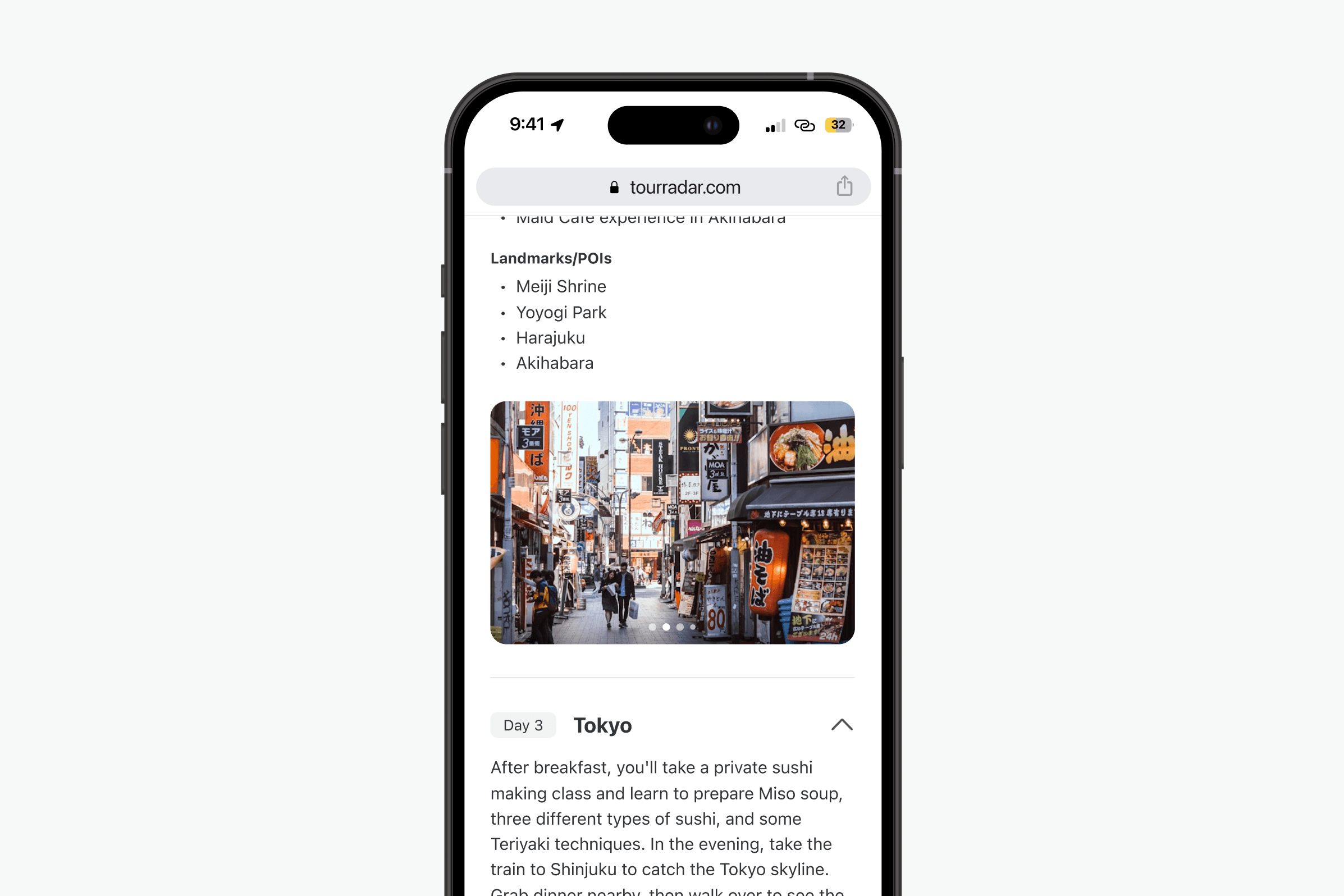
The existing points of interest gallery sat separately from the itinerary content, which user surveys flagged as a disconnect. Users wanted to know which landmarks they would visit on which day. I moved the gallery into the itinerary itself at a day level, giving users a richer, more contextual experience.
Designing for future media types while protecting existing metrics
The new layout was designed to accommodate video and other media at the day level in future iterations. Before building out that functionality, we ran A/B testing to confirm the new layout did not negatively impact micro-conversions and other on-page metrics, so we could expand confidently.
